Pokemon Card Dimensions: Complete Size Guide for Every Card Type With Facts
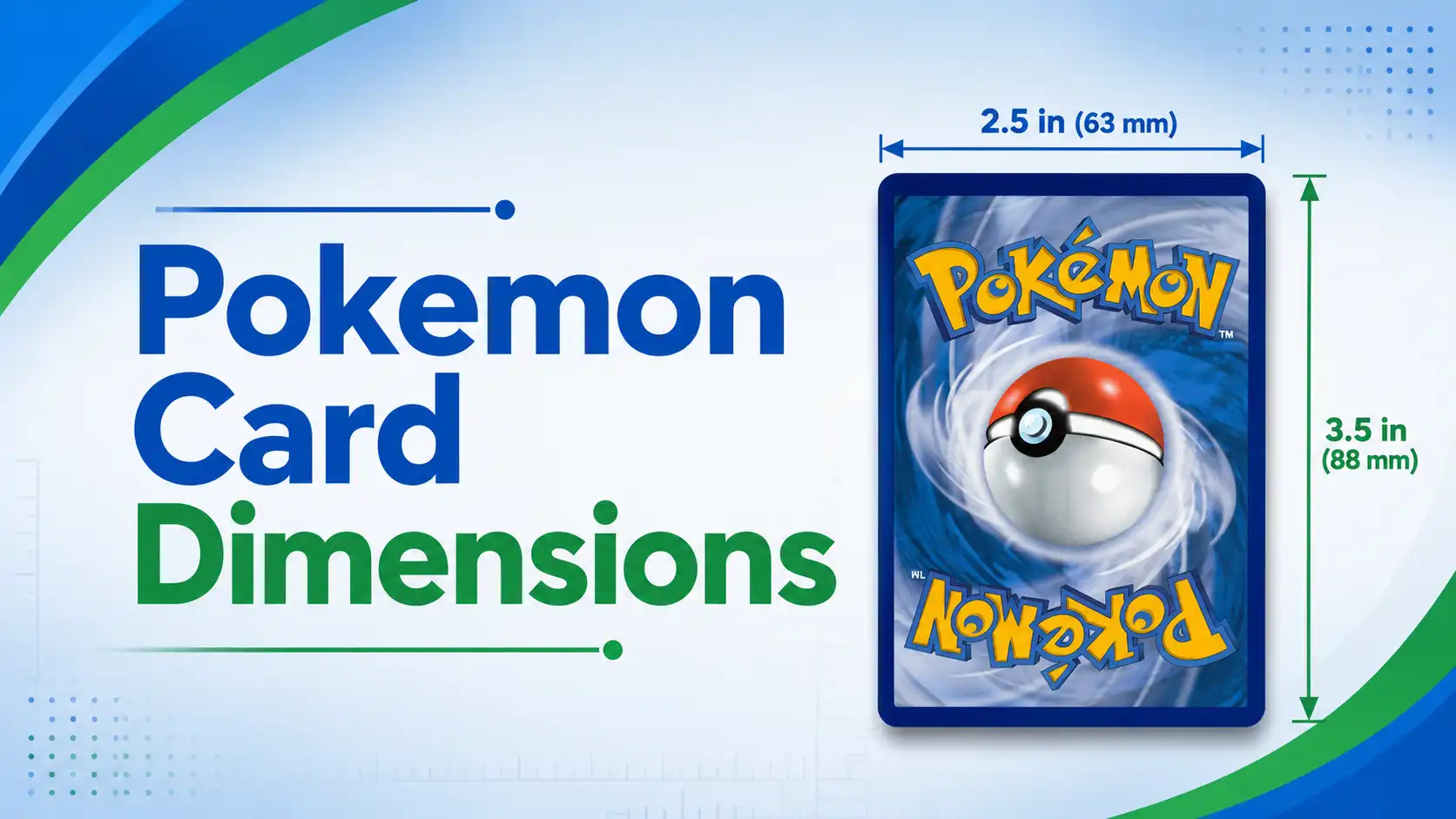
Pokemon card dimensions are 2.5 × 3.5 inches (63 × 88 mm) for standard cards, making them the same size as most poker-style trading cards. A typical Pokémon card is about 0.30–0.34 mm thick, though slight manufacturing variations of ±0.5–1 mm in size and thickness can occur depending on the print run and card type.
Introduction
Have you ever bought a new sleeve, binder, or top loader only to wonder whether your Pokémon cards would actually fit? Knowing the exact Pokemon card dimensions is important whether you’re collecting rare cards, building tournament decks, shipping valuable singles, or submitting cards for grading.
After comparing measurements from multiple collector references and checking standard Pokémon TCG specifications, one thing becomes clear: although most Pokémon cards follow a consistent standard size, oversized promo cards, jumbo cards, and regional releases can differ significantly.
Understanding these differences helps you choose the right accessories, protect valuable cards, and avoid buying incompatible storage products.
In this guide, you’ll learn the exact dimensions of every major Pokémon card type in inches, millimeters, and centimeters, along with sleeve recommendations, grading advice, storage tips, and practical comparisons that go beyond what most online size guides cover.
Key Takeaways
- Standard Pokémon cards measure 2.5 × 3.5 inches (63 × 88 mm).
- Standard cards are approximately 0.30–0.34 mm thick.
- Multiple oversized formats exist, including Box Topper, Jumbo L, Jumbo XL, and CoroCoro XXL.
- Measurements are provided in inches, millimeters, and centimeters.
- Includes sleeve, binder, deck box, grading, and shipping recommendations.
- Learn how size and thickness can help identify counterfeit cards.
Pokemon Card Dimensions Size Chart
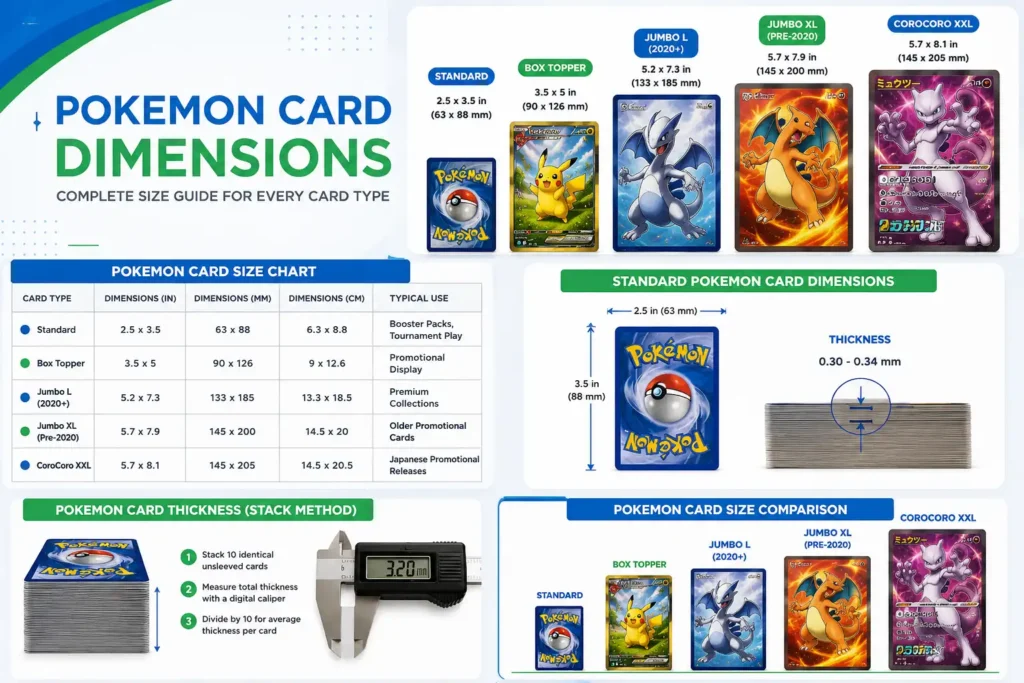
The table below provides a quick overview of the most common Pokémon card sizes. These measurements are based on the dimensions most widely used by collectors and manufacturers. Slight production tolerances of around ±0.5–1 mm are normal.
| Card Type | Dimensions (inches) | Dimensions (mm) | Dimensions (cm) | Typical Use | Sleeve / Protection |
|---|---|---|---|---|---|
| Standard | 2.5 × 3.5 | 63 × 88 | 6.3 × 8.8 | Booster packs, tournament play | Standard TCG sleeves |
| Box Topper | 3.5 × 5 | 90 × 126 | 9 × 12.6 | Promotional display | Oversized sleeves |
| Jumbo L (2020+) | 5.2 × 7.3 | 133 × 185 | 13.3 × 18.5 | Premium collections | Jumbo sleeves |
| Jumbo XL (Pre-2020) | 5.7 × 7.9 | 145 × 200 | 14.5 × 20 | Older promotional cards | XL sleeves |
| CoroCoro XXL | 5.7 × 8.1 | 145 × 205 | 14.5 × 20.5 | Japanese promotional releases | Custom protection |
Standard Pokemon Card Dimensions

The standard Pokémon Trading Card Game card follows the same dimensions as a traditional poker-sized playing card. This universal sizing makes it compatible with thousands of accessories available worldwide.
Standard Card Specifications
| Specification | Measurement |
|---|---|
| Length | 3.5 in (88 mm) |
| Width | 2.5 in (63 mm) |
| Thickness | 0.30–0.34 mm |
| Weight | Approximately 1.7–1.9 g |
| Corner Style | Rounded |
| Sleeve Compatibility | Standard TCG sleeves |
| Tournament Legal | Yes |
The standard format has remained remarkably consistent throughout the history of the Pokémon Trading Card Game. Maintaining a fixed size ensures every official card fits standard sleeves, deck boxes, binders, and shuffling accessories used in organized play.
Most English-language Pokémon cards, including common, uncommon, rare, holo, EX, GX, V, VMAX, VSTAR, and Illustration Rare cards, follow these dimensions.
For collectors, this consistency also simplifies grading and long-term storage. Accessories designed for poker-sized trading cards generally work perfectly with standard Pokémon cards.
Why Are Pokémon Cards This Size?
Many collectors assume Pokémon cards were given unique dimensions, but that’s not actually the case.
Instead, the Pokémon Trading Card Game adopted the existing poker-card standard (63 × 88 mm). Using this well-established format offered several advantages:
- Lower manufacturing costs
- Existing printing equipment
- Easy shuffling during gameplay
- Compatibility with already available sleeves
- Standardized storage products
- Faster worldwide production
Because of this decision, many accessories designed for trading cards also work with Pokémon cards.
Standard Card Thickness
Length and width remain extremely consistent, but thickness can vary slightly.
Most standard Pokémon cards measure approximately:
0.30–0.34 mm
Factors affecting thickness include:
- Print era
- Printing facility
- Foil layers
- Card stock composition
- Manufacturing tolerances
A difference of around ±0.02 mm in thickness is considered normal, while slight dimensional variations of ±0.5–1 mm may occur across different print runs.
Box Topper Pokemon Card Dimensions
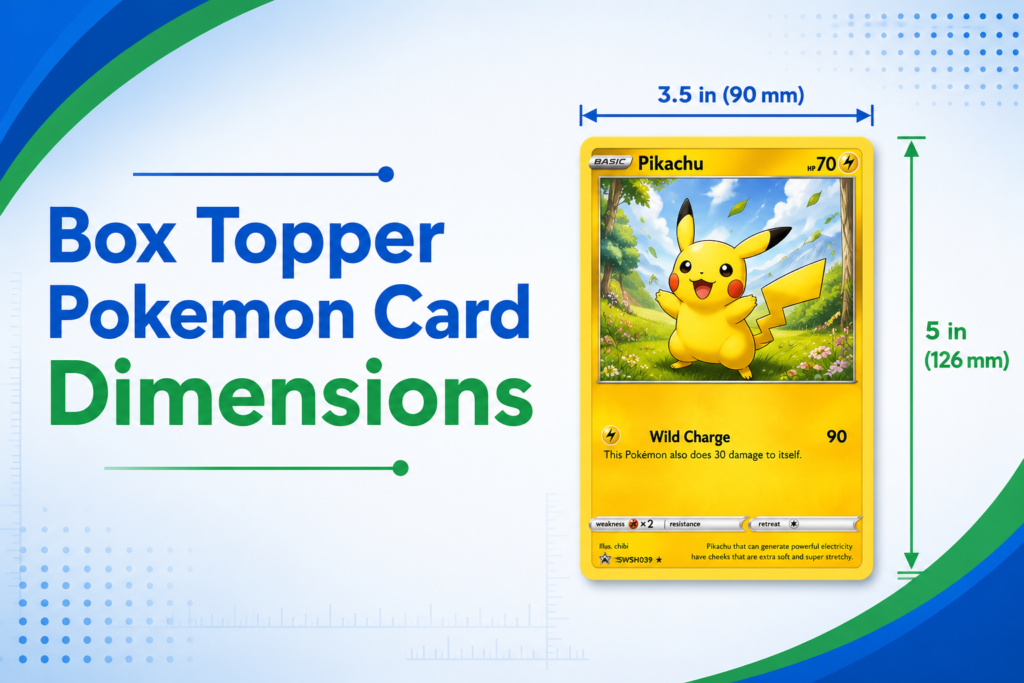
Box Topper cards are oversized promotional cards released with selected Pokémon products. Unlike standard cards, they are designed primarily for display rather than gameplay.
Box Topper Specifications
| Measurement | Size |
|---|---|
| Length | 5 in (126 mm) |
| Width | 3.5 in (90 mm) |
| Thickness | Similar to standard cards |
| Fits Standard Sleeve | No |
| Best For | Display collections |
Although they resemble regular Pokémon cards in artwork and finish, their larger footprint prevents them from fitting into standard binders or deck boxes. Collectors typically store Box Topper cards in oversized sleeves, archival pages, or custom display frames to prevent edge wear and bending.
Their increased size also makes them attractive display pieces, especially for promotional artwork that benefits from a larger printing area.
Jumbo L Pokemon Card Dimensions (2020–Present)
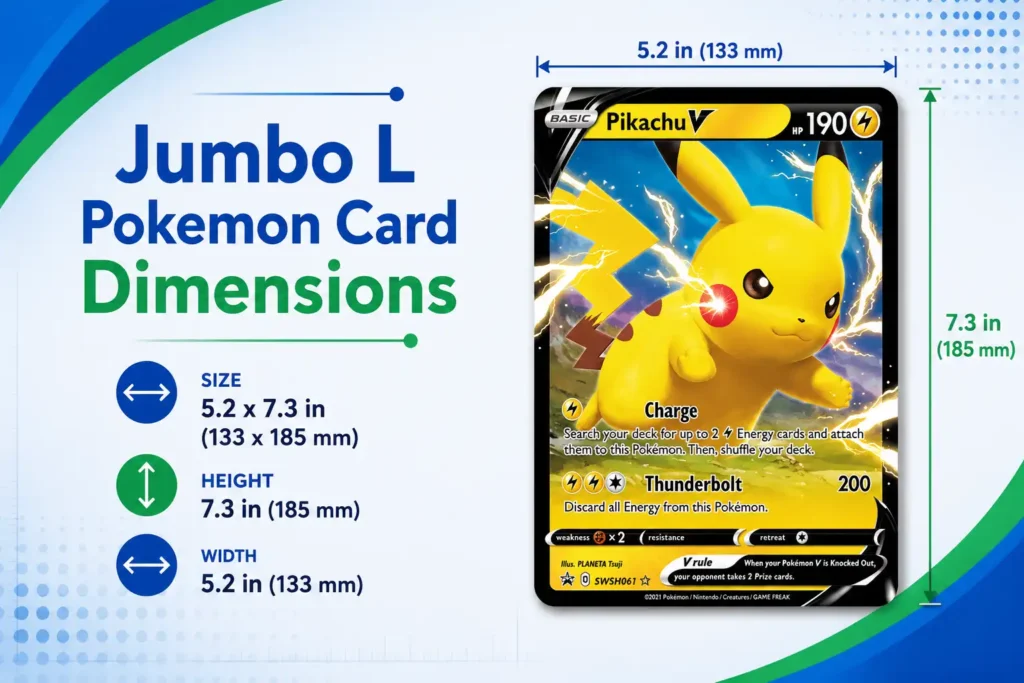
Beginning in 2020, The Pokémon Company International introduced a smaller jumbo format for many premium collections. Compared to older oversized cards, these are easier to store and display while still showcasing the artwork in greater detail than a standard card.
Jumbo L Specifications
| Specification | Measurement |
|---|---|
| Length | 7.3 in (185 mm) |
| Width | 5.2 in (133 mm) |
| Thickness | Similar to standard cards (approximately 0.30–0.34 mm) |
| Card Stock | Laminated Pokémon cardstock |
| Fits Standard Sleeve | ❌ No |
| Best For | Display, premium collections, oversized binders |
Modern Jumbo L Pokémon cards measure approximately 7.3 inches in height. If you’re wondering how large that really is, our guide on 7 inches compares it with everyday objects to help you visualize the card’s actual size.
The reduced jumbo format offers a better balance between visual impact and practicality. Many modern oversized binders and sleeves are now designed specifically for these dimensions, making storage much easier than with earlier jumbo releases.
Collectors often receive Jumbo L cards in premium collection boxes featuring Pokémon V, VMAX, VSTAR, or ex promotional cards. Although they feature the same artwork as playable cards, they are intended solely for collecting and display.
Why Choose Jumbo L Cards?
Jumbo L cards are popular because they:
- Showcase artwork in greater detail.
- Fit newer oversized binder pages.
- Display well in frames and stands.
- Are easier to store than older jumbo formats.
- Add visual appeal to premium Pokémon collections.
Jumbo XL Pokemon Card Dimensions (Pre-2020)
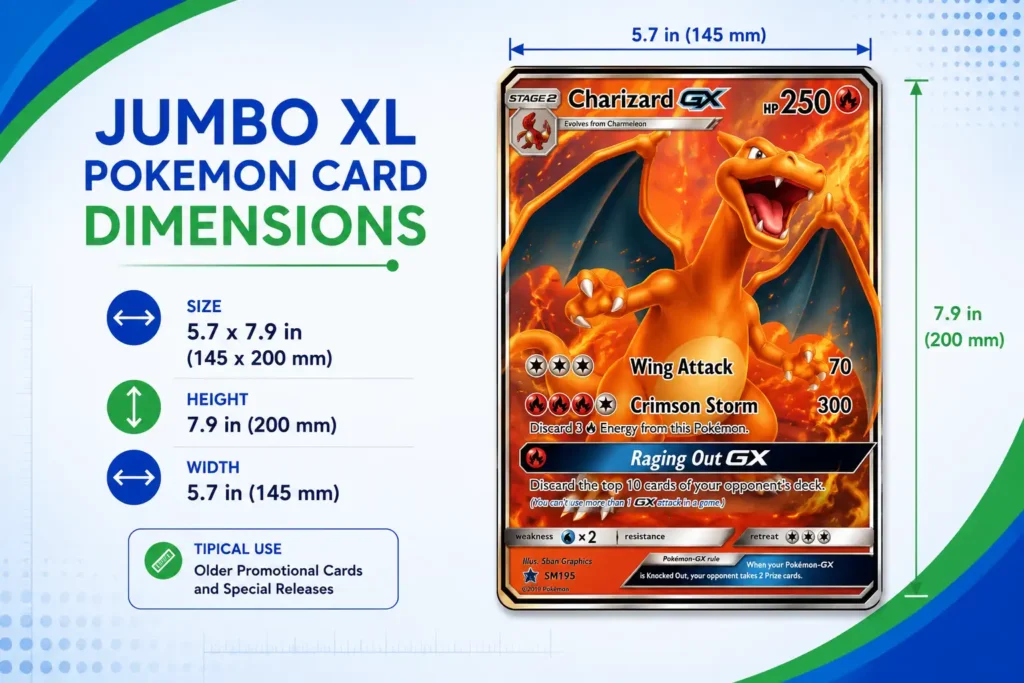
Before 2020, Pokémon released a larger oversized format that collectors commonly refer to as Jumbo XL. These cards were included in many GX, EX, and Legendary Collection products.
Jumbo XL Specifications
| Specification | Measurement |
|---|---|
| Length | 7.9 in (200 mm) |
| Width | 5.7 in (145 mm) |
| Thickness | Approximately the same as standard cards |
| Fits Standard Sleeve | ❌ No |
| Best For | Display and collecting |
These older jumbo cards are noticeably larger than the current Jumbo L format. Because of their size, finding compatible sleeves, binders, and storage products can be more challenging.
Many collectors choose rigid archival sleeves or custom display frames to protect these oversized promotional cards.
Why Were Older Jumbo Cards Bigger?
The earliest oversized Pokémon cards were created primarily as promotional display pieces rather than practical collectibles. Their larger dimensions made them stand out inside premium collection boxes and helped emphasize special artwork.
However, collectors frequently reported storage difficulties. As a result, newer premium products transitioned to the smaller Jumbo L format, which remains the standard oversized size today.
CoroCoro XXL Pokemon Card Dimensions
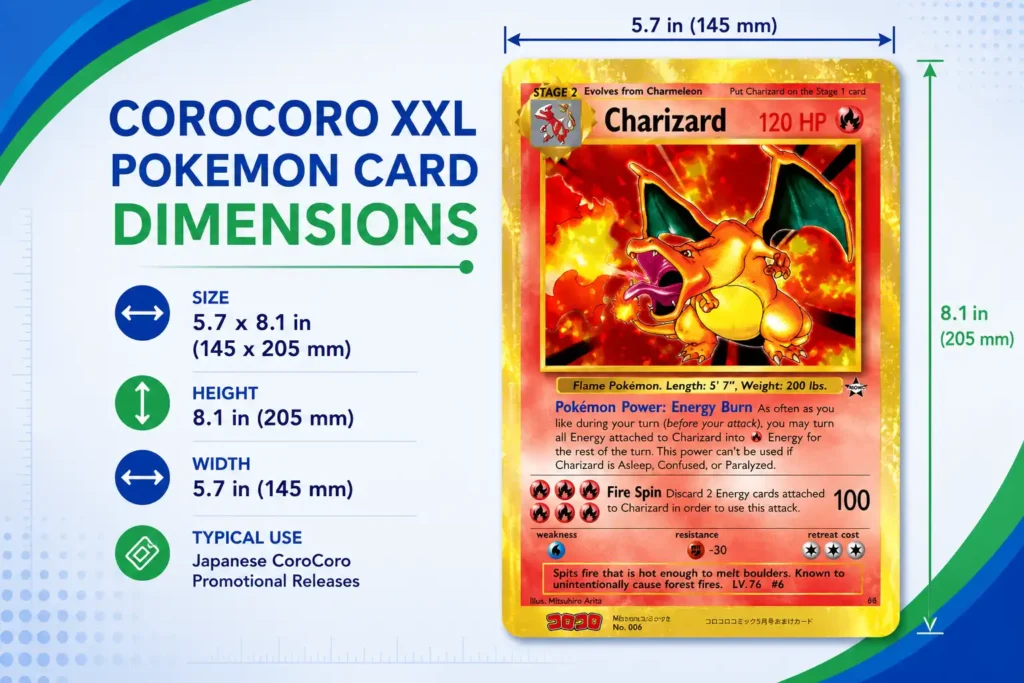
Some of the rarest oversized Pokémon cards originated from Japanese promotional releases, particularly those distributed through CoroCoro Comic magazine.
CoroCoro XXL Specifications
| Specification | Measurement |
|---|---|
| Length | 8.1 in (205 mm) |
| Width | 5.7 in (145 mm) |
| Thickness | Similar to other oversized cards |
| Sleeve Compatibility | Custom archival protection recommended |
| Best For | Rare Japanese collections and display |
Since CoroCoro XXL cards are just over 8 inches tall, they require specialized storage and display solutions. See our 8 inches guide to compare this size with familiar household objects.
Unlike modern jumbo cards, CoroCoro promotional cards were produced in limited quantities and often served as collector memorabilia rather than game pieces.
Because replacement sleeves and binders for this format are uncommon, many collectors prefer:
- Acid-free archival sleeves
- Custom acrylic cases
- Museum-quality display frames
- Flat storage portfolios
These options help reduce edge wear and prevent bending over time.
Pokemon Card Size Compared to Everyday Objects
Visualizing card dimensions can make it easier to choose the right storage accessories or display options.
| Pokémon Card Size | Comparable Everyday Object | Why It Helps |
|---|---|---|
| Standard (2.5 × 3.5 in) | Standard playing card | Fits most card sleeves, binders, and deck boxes. |
| Box Topper | Small greeting card | Easier to picture display size. |
| Jumbo L | Small postcard | Useful for selecting frames and oversized binders. |
| Jumbo XL | Half-sheet notebook | Shows why standard accessories won’t fit. |
| CoroCoro XXL | Large postcard | Helps estimate display and storage requirements. |
Thinking of Pokémon cards alongside familiar objects makes shopping for protective accessories much simpler, especially when buying online.
Pokémon Card Size Compared with Other Trading Card Games
Although Pokémon cards share a common standard with many trading card games, there are important differences to keep in mind.
| Trading Card Game | Standard Size | Notes |
|---|---|---|
| Pokémon TCG | 2.5 × 3.5 in (63 × 88 mm) | Industry-standard poker size. |
| Magic: The Gathering | 2.5 × 3.5 in (63 × 88 mm) | Identical dimensions; most accessories are interchangeable. |
| Yu-Gi-Oh! | 2.32 × 3.38 in (59 × 86 mm) | Slightly narrower and shorter, requiring smaller sleeves. |
| Sports Cards (Baseball, Basketball, Football) | 2.5 × 3.5 in (63 × 88 mm) | Uses the same standard dimensions as Pokémon. |
What Does This Mean for Accessories?
- Standard Pokémon sleeves generally fit Magic: The Gathering and most sports cards.
- Yu-Gi-Oh! cards require smaller sleeves because they are approximately 4 mm narrower.
- Standard 9-pocket binder pages are designed for 63 × 88 mm cards, making them compatible with Pokémon, Magic, and most sports trading cards.
Understanding these similarities can help collectors avoid buying the wrong sleeves, binders, or deck boxes, especially when managing multiple trading card games.
Practical Uses of Pokemon Card Dimensions
Knowing the exact Pokemon card dimensions isn’t just useful for curiosity—it directly affects how well your cards are protected, stored, displayed, and even graded. Choosing the wrong sleeve or storage product can lead to bent corners, loose-fitting cards, or unnecessary wear over time.
Whether you’re a casual player, competitive Pokémon TCG enthusiast, or serious collector, matching your accessories to the correct card dimensions helps preserve your collection for years.
Pokemon Card Sleeve Size Guide
One of the first accessories every collector buys is a card sleeve. Since standard Pokémon cards measure 2.5 × 3.5 inches (63 × 88 mm), they fit standard trading card sleeves designed for poker-sized cards.
Sleeve Compatibility Chart
| Sleeve Type | Typical Size | Fits Standard Pokémon Cards? | Best Use |
|---|---|---|---|
| Perfect Fit (Inner Sleeve) | 64 × 89 mm | ✅ Yes | Double sleeving, premium protection |
| Standard Sleeve | 66 × 91 mm | ✅ Yes | Everyday play and storage |
| Premium Matte Sleeve | 66 × 91 mm | ✅ Yes | Tournament play |
| Penny Sleeve | 67 × 94 mm | ✅ Yes | Budget storage |
| Oversized Sleeve | Various | ❌ Only for Jumbo Cards | Display and collectibles |
Perfect-fit sleeves hug the card closely, making them ideal for collectors who also use an outer sleeve. Standard sleeves leave a small margin around the card, offering better protection while remaining easy to shuffle.
If you’re protecting valuable holo, Illustration Rare, or vintage cards, double sleeving with an inner sleeve and a premium outer sleeve provides the highest level of everyday protection.
Which Sleeve Brands Work Best?
Popular sleeve manufacturers include:
- Ultra PRO
- Dragon Shield
- KMC Perfect Fit
- Gamegenic
- Ultimate Guard
These brands manufacture sleeves specifically for 63 × 88 mm trading cards, making them suitable for Pokémon TCG.
Top Loader Compatibility
Top loaders provide rigid protection for valuable cards during storage, shipping, or grading preparation.
| Protection Type | Fits Standard Card | Recommended For |
|---|---|---|
| 35 pt Top Loader | ✅ Yes | Most Pokémon cards |
| Semi-Rigid Holder | ✅ Yes | PSA submissions |
| Magnetic One-Touch Case | ✅ Yes | Displaying valuable cards |
| Oversized Top Loader | Jumbo only | Promotional cards |
Rigid holders significantly reduce the risk of bent corners, surface scratches, and edge damage, especially during transport.
Binder Compatibility
Most collectors organize their cards in binders. Fortunately, standard Pokémon cards fit nearly all trading card binders designed for poker-sized cards.
Binder Guide
| Binder Type | Compatible | Best For |
|---|---|---|
| 9-Pocket Binder | ✅ Yes | Complete collections |
| 12-Pocket Binder | ✅ Yes | Large sets |
| Side-Loading Binder | ✅ Yes | Maximum protection |
| Jumbo Binder | Jumbo Cards Only | Oversized collections |
Side-loading binders are generally preferred because they reduce the likelihood of cards slipping out if the binder is turned upside down.
For oversized promotional cards, choose binders specifically designed for jumbo formats.
Deck Box Compatibility
Deck boxes are designed to hold sleeved cards securely while protecting them during travel.
Approximate Deck Box Capacity
| Deck Box | Capacity |
|---|---|
| Small Deck Box | 60 sleeved cards |
| Standard Deck Box | 75–100 sleeved cards |
| Double Deck Box | 150–200 sleeved cards |
| Storage Box | 500–5000 cards |
Since Pokémon uses the standard 63 × 88 mm card format, nearly every trading card deck box on the market is compatible.
Collectors storing expensive cards should avoid overfilling deck boxes, as excessive pressure may cause edge whitening over time.
PSA, BGS & CGC Grading Preparation
Professional grading companies such as PSA, Beckett Grading Services (BGS), and CGC Cards expect cards to remain within normal manufacturing tolerances.
Before submitting a card:
- Measure the card while unsleeved.
- Check for trimmed or uneven edges.
- Inspect corner rounding.
- Verify the card isn’t unusually thick or thin.
- Store the card in a semi-rigid holder before shipping.
Cards that appear noticeably smaller or larger than the expected 63 × 88 mm dimensions may receive additional scrutiny, particularly if trimming is suspected.
Although slight variations of approximately ±0.5–1 mm can occur due to manufacturing, significant differences may indicate damage or alteration.
Shipping Pokemon Cards Safely
Proper packaging helps prevent damage during transit, whether you’re selling individual cards online or sending cards for grading.
Recommended Shipping Setup
| Item | Recommendation |
|---|---|
| Inner Sleeve | Perfect Fit |
| Outer Sleeve | Standard Sleeve |
| Rigid Protection | Top Loader or Semi-Rigid Holder |
| Team Bag | Prevents sliding |
| Bubble Mailer | Ideal for valuable cards |
| Cardboard Support | Prevents bending |
Avoid placing unsleeved cards directly inside envelopes, as this can easily result in bent corners or surface scratches.
For expensive cards, consider using tracking and additional insurance when shipping.
Display & Framing Tips
If you enjoy displaying your collection, selecting the right frame or display stand is just as important as choosing proper storage.
For standard cards:
- Acrylic stands work well for showcase pieces.
- Magnetic display cases offer premium protection.
- UV-resistant frames help reduce fading caused by sunlight.
For jumbo promotional cards:
- Choose frames made specifically for oversized trading cards.
- Use acid-free backing materials.
- Avoid direct sunlight to minimize long-term color fading.
Displaying cards properly preserves both their appearance and potential collectible value.
Quick Compatibility Reference
| Accessory | Standard Cards | Jumbo Cards |
|---|---|---|
| Standard Sleeves | ✅ | ❌ |
| Perfect Fit Sleeves | ✅ | ❌ |
| Penny Sleeves | ✅ | ❌ |
| Top Loaders | ✅ | Oversized Required |
| 9-Pocket Binder | ✅ | ❌ |
| Jumbo Binder | ❌ | ✅ |
| Deck Box | ✅ | ❌ |
| PSA Holder | ✅ | ❌ |
| Acrylic Display | ✅ | ✅ (Oversized Version) |
How to Measure a Pokemon Card Correctly
If you want to verify a card’s authenticity, buy the right accessories, or prepare it for professional grading, measuring it correctly is essential. Even a small mistake—such as measuring a sleeved card—can produce inaccurate results.
For the most reliable measurements, always measure the card while it is unsleeved, placed on a flat surface, and free from bends or warping.
Tools You’ll Need
The right tools make a noticeable difference in measurement accuracy.
| Tool | Purpose | Accuracy |
|---|---|---|
| Steel ruler | Length and width | Good |
| Digital caliper | Length, width, and thickness | Excellent |
| Precision caliper | Professional grading preparation | Best |
| Flat table | Prevents measurement errors | Essential |
Collectors submitting valuable cards to PSA, BGS, or CGC Cards often prefer digital calipers because they provide much more precise readings than a standard ruler.
Step 1: Measure the Length
Lay the card flat on a hard surface and measure from the top edge to the bottom edge.
For a standard Pokémon card, the expected measurement is:
3.5 inches (88 mm)
Do not include sleeves, top loaders, or protective cases while measuring.
Step 2: Measure the Width
Next, measure from the left edge to the right edge.
A standard Pokémon card should measure:
2.5 inches (63 mm)
If your measurement differs slightly, check whether the ruler is perfectly aligned before assuming the card is incorrect.
Step 3: Measure the Thickness
Thickness is harder to measure because a single card is extremely thin.
Instead of measuring one card, many collectors use the stack method:
- Stack 10 identical unsleeved cards.
- Measure the total thickness with a digital caliper.
- Divide the result by 10.
This method reduces small measurement errors and provides a more accurate average thickness.
Most authentic standard Pokémon cards measure approximately:
0.30–0.34 mm
Depending on the print run, cardstock, and foil layer, small differences are perfectly normal.
Common Measurement Mistakes
Avoid these common errors:
- Measuring the card while it’s inside a sleeve.
- Using a flexible tape measure.
- Measuring bent or warped cards.
- Including the protective case in the measurement.
- Rounding measurements too aggressively.
Even a high-quality ruler can produce inaccurate results if it isn’t aligned precisely with the card’s edges.
Why Are Pokemon Cards This Size?
The dimensions of Pokémon cards weren’t chosen at random. Instead, they follow the long-established poker-card standard used throughout the trading card industry.
Using a standard size offers practical advantages for manufacturers, retailers, and players alike.
Manufacturing Efficiency
Producing millions of cards each year requires highly efficient printing and cutting processes. By adopting the 63 × 88 mm format, Pokémon cards can be manufactured using the same industrial equipment and production methods used for many other trading card games.
This standardization helps:
- Reduce manufacturing costs.
- Improve printing consistency.
- Minimize production waste.
- Maintain compatibility with existing accessories.
Better Gameplay Experience
A standardized card size also improves gameplay.
Cards are:
- Comfortable to hold.
- Easy to shuffle.
- Convenient to organize.
- Simple to transport in deck boxes.
If Pokémon cards were significantly larger or smaller, shuffling and handling large decks during tournaments would become much less practical.
Accessory Compatibility
One of the biggest advantages of using the poker-card standard is universal compatibility.
Because Pokémon cards share their dimensions with many other trading cards, collectors can easily find:
- Sleeves
- Top loaders
- Deck boxes
- Binder pages
- Storage boxes
- Display cases
This wide availability keeps accessory prices competitive and gives collectors more options to choose from.
Why Do Jumbo Cards Exist?

Oversized Pokémon cards aren’t intended for tournament play. Instead, they’re designed to celebrate special releases and showcase artwork on a much larger canvas.
Jumbo cards are commonly included in:
- Premium Collection Boxes
- Special Anniversary Sets
- Promotional Products
- Limited Collector Editions
Their larger format makes them ideal for display but impractical for standard gameplay.
Japanese vs International Pokemon Card Dimensions
A common misconception is that Japanese Pokémon cards use different dimensions from English-language cards.
In reality, modern Japanese and International Pokémon cards share the same standard dimensions of approximately 63 × 88 mm. This means they generally fit the same sleeves, binders, and deck boxes.
However, collectors may notice small differences in:
- Cardstock feel
- Surface finish
- Print quality
- Color saturation
- Manufacturing tolerances
These differences are related to production methods rather than overall card size.
Quick Comparison
| Feature | Japanese Cards | International Cards |
|---|---|---|
| Length | 88 mm | 88 mm |
| Width | 63 mm | 63 mm |
| Sleeve Compatibility | Standard TCG Sleeves | Standard TCG Sleeves |
| Thickness | Slight variation possible | Slight variation possible |
| Tournament Size | Standard | Standard |
Minor differences of ±0.5–1 mm can occur due to manufacturing tolerances, but these are not unique to Japanese cards and may be seen across different print runs.
Can Card Dimensions Help Identify Counterfeit Pokemon Cards?
While size alone can’t confirm whether a Pokémon card is genuine, it can provide useful clues when combined with other authenticity checks.
Counterfeit cards sometimes differ slightly from official specifications because of lower-quality printing and cutting equipment.
Common Signs of Fake Cards
- Noticeably different length or width.
- Unusual thickness.
- Poorly rounded corners.
- Inconsistent edge cuts.
- Low-quality cardstock.
- Colors that appear faded or overly saturated.
- Glossy or matte finish that doesn’t match authentic cards.
Comparing a suspected card directly with a confirmed authentic Pokémon card is often one of the quickest ways to spot obvious differences.
Acceptable Manufacturing Tolerance
Authentic Pokémon cards are not always identical down to the fraction of a millimeter.
In general:
- Variations of ±0.5–1 mm in length or width can occur due to manufacturing.
- Slight thickness differences may result from different print facilities, card finishes, or production batches.
A card that falls well outside these tolerances should be examined more carefully, especially if other warning signs are present.
Quick Authenticity Checklist
| Check | Authentic Card | Possible Counterfeit |
|---|---|---|
| Dimensions | Around 63 × 88 mm | Noticeably different |
| Thickness | Approximately 0.30–0.34 mm | Much thicker or thinner |
| Corners | Smooth, evenly rounded | Uneven or sharp |
| Cardstock | Firm and consistent | Soft or flimsy |
| Print Quality | Sharp text and colors | Blurry or inconsistent |
Remember that measurements are only one part of the authentication process. Printing quality, cardstock construction, and other security features should also be considered before reaching a conclusion.
Conclusion
Understanding Pokemon card dimensions makes it much easier to buy the right sleeves, binders, deck boxes, and display accessories while protecting your collection from unnecessary wear. Standard Pokémon cards measure 2.5 × 3.5 inches (63 × 88 mm) and are compatible with most poker-sized trading card accessories, while jumbo and promotional cards require specialized storage solutions.
Whether you’re organizing a competitive deck, preparing valuable cards for PSA, BGS, or CGC Cards, or simply preserving your favorite collection, using the correct dimensions helps prevent damage and ensures a better fit for every accessory. Keep in mind that small manufacturing tolerances of ±0.5–1 mm are normal, so always compare measurements alongside other authenticity checks rather than relying on size alone.
If you found this guide helpful, bookmark it for future reference and explore our other trading card size guides on SizeExplained.com.
Frequently Asked Questions (FAQ)
What are the Dimensions of a Standard Pokémon Card?
A standard Pokémon card measures 2.5 × 3.5 inches (63 × 88 mm). This is the same size as most poker-style playing cards and is compatible with standard trading card sleeves, binders, and deck boxes.
What Size Sleeves fit Pokémon Cards?
Most standard Pokémon cards fit sleeves designed for 63 × 88 mm trading cards. Popular options include perfect-fit inner sleeves, standard sleeves, and premium matte sleeves from brands such as Ultra PRO, Dragon Shield, and KMC.
How Thick is a Pokémon Card?
A standard Pokémon card is typically 0.30–0.34 mm thick. Small variations may occur depending on the print run, cardstock, and foil finish.
Are Japanese Pokémon Cards the Same Size as English Cards?
Yes. Modern Japanese and International Pokémon cards both use the standard 63 × 88 mm dimensions, allowing them to fit the same sleeves, binders, and storage accessories. Minor manufacturing tolerances are normal.
Are Jumbo Pokémon Cards Playable?
No. Jumbo cards are promotional collectibles intended for display rather than tournament play. They are significantly larger than standard Pokémon cards and require oversized sleeves or custom storage solutions.
Can Fake Pokémon Cards have Different Dimensions?
Sometimes. Counterfeit cards may be slightly larger, smaller, thicker, or thinner than official cards. However, size alone cannot confirm authenticity, so it should be considered alongside print quality, cardstock, and other identifying features.
What Size Top Loader Fits Pokémon Cards?
A standard 35-point top loader is suitable for most regular Pokémon cards. Oversized promotional cards require jumbo-sized rigid holders or custom protective cases.
Do Pokémon Cards fit Standard 9-Pocket Binders?
Yes. Standard Pokémon cards fit most 9-pocket and 12-pocket trading card binders designed for poker-sized cards. Jumbo cards require dedicated oversized binder pages.