Aluminum Can Dimensions: Complete Size Chart (6 oz–19.2 oz)
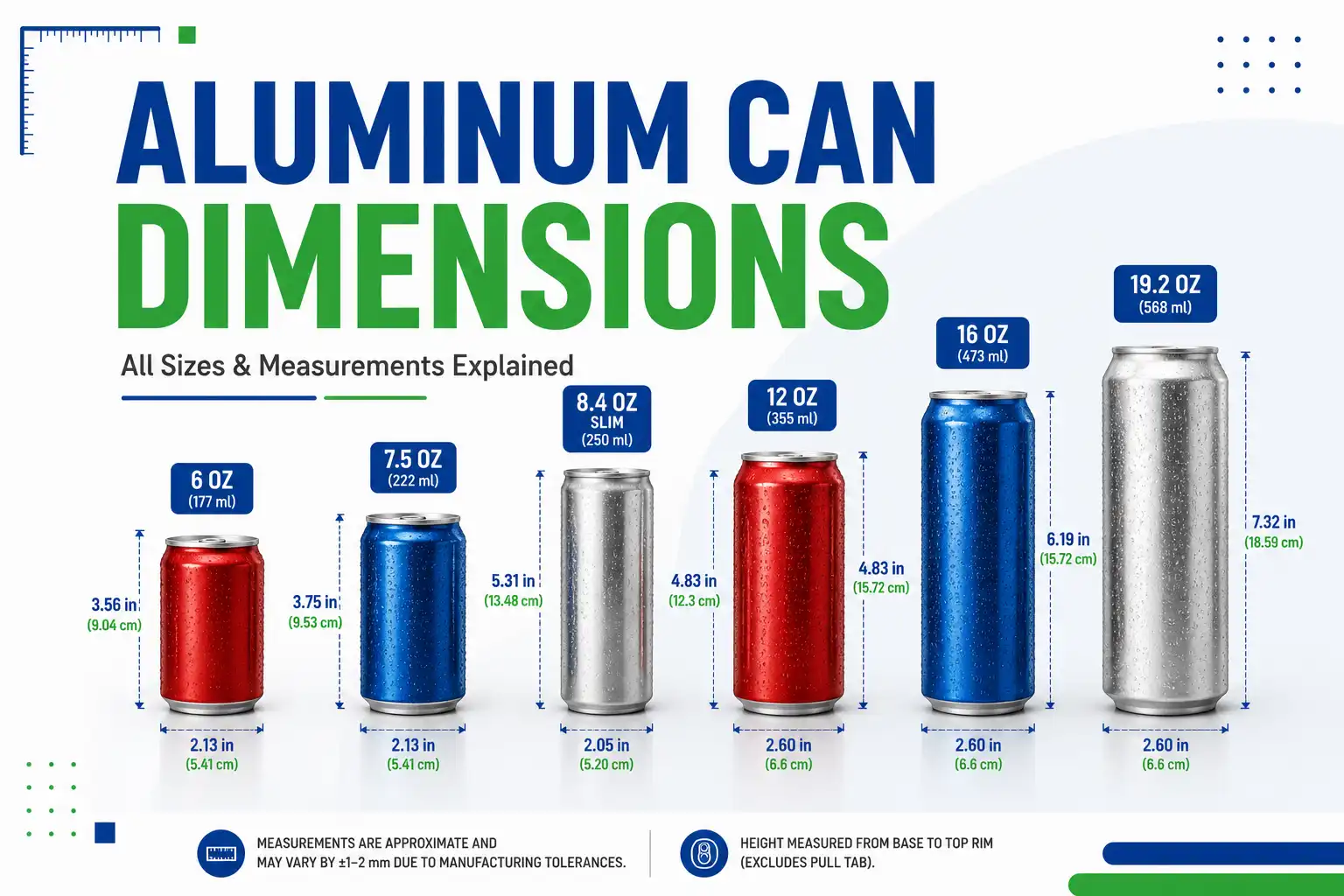
The most common aluminum can dimensions are approximately 4.83 inches (12.3 cm) tall with a body diameter of 2.60 inches (6.6 cm) for a standard 12 oz beverage can. Smaller and larger aluminum cans range from about 3.95 to 7.40 inches (10–18.8 cm) in height while keeping relatively consistent diameters for compatibility with filling equipment and cup holders.
Introduction
Have you ever wondered why some aluminum beverage cans are short and compact while others are noticeably taller, yet nearly all of them still fit comfortably in your car’s cup holder? The answer lies in standardized manufacturing dimensions that balance capacity, strength, portability, and production efficiency.
After comparing commonly available beverage cans from multiple manufacturers and industry specifications, we found that while heights vary considerably between sizes, the body diameter changes very little across most aluminum beverage cans.
In this guide, you’ll find exact aluminum can dimensions in both inches and centimeters, comparison tables, practical storage tips, engineering insights, and measurement advice for manufacturers, designers, retailers, students, and everyday consumers.
Key Takeaways
- Covers all six common aluminum beverage can sizes (6 oz, 7.5 oz, 8.4 oz, 12 oz, 16 oz, and 19.2 oz)
- Measurements provided in both inches and centimeters
- Includes height, diameter, circumference, and typical applications
- Helpful for packaging design, retail shelving, CAD models, and storage planning
- Explains why industry-standard dimensions exist
- Includes practical guidance for cup holders, refrigerators, and shipping.
Aluminum Can Dimensions Size Chart
| Can Size | Capacity | Height (in) | Height (cm) | Diameter (in) | Diameter (cm) | Circumference |
|---|---|---|---|---|---|---|
| 6 oz | 177 ml | 3.95 | 10.0 | 2.13 | 5.41 | 6.69 in (17.0 cm) |
| 7.5 oz | 222 ml | 4.13 | 10.5 | 2.13 | 5.41 | 6.69 in (17.0 cm) |
| 8.4 oz Slim | 250 ml | 5.33 | 13.5 | 2.05 | 5.20 | 6.44 in (16.4 cm) |
| 12 oz Standard | 355 ml | 4.83 | 12.3 | 2.60 | 6.60 | 8.17 in (20.7 cm) |
| 16 oz | 473 ml | 6.19 | 15.7 | 2.60 | 6.60 | 8.17 in (20.7 cm) |
| 19.2 oz | 568 ml | 7.40 | 18.8 | 2.60 | 6.60 | 8.17 in (20.7 cm) |
Measurement Note: Heights represent the can body measured from the base to the top rim, excluding the raised pull tab. Actual production cans may vary by approximately ±1–2 mm depending on the manufacturer and production line.
Why Aluminum Can Dimensions Matter

Whether you’re designing retail packaging, building a 3D model, planning refrigerator storage, or simply checking whether a beverage fits your vehicle’s cup holder, understanding aluminum can dimensions makes the job much easier.
Manufacturers use standardized dimensions because modern filling lines, labeling machines, shipping cartons, vending machines, and recycling systems are all engineered around predictable can sizes. Even small changes in diameter can require major adjustments to production equipment.
For packaging designers, accurate measurements ensure labels wrap correctly without distortion. Retailers rely on consistent dimensions to maximize shelf space and pallet efficiency. Students studying packaging engineering often use aluminum cans as examples of standardized industrial design because they combine lightweight construction with excellent structural strength.
Another important distinction is body diameter versus lid diameter. The body diameter is the widest part of the can and is used for storage calculations, label design, and cup-holder compatibility. The lid opening is intentionally smaller, improving structural rigidity while reducing material usage.
Finally, remember that can height changes much more frequently than diameter. Increasing height allows manufacturers to offer larger beverage capacities while maintaining compatibility with existing filling equipment and consumer accessories.
6 oz Aluminum Can Dimensions (177 ml)

The 6 oz aluminum can is one of the smallest beverage cans commonly available in North America. You’ll often find it used for children’s drinks, portion-controlled soft drinks, sparkling water, promotional beverages, and airline service. Its compact size makes it ideal when a full-sized can would be more than needed.
Although it holds less liquid than a standard soda can, manufacturers keep many design elements consistent so the can remains compatible with existing filling and packaging equipment.
Dimensions
| Specification | Measurement |
|---|---|
| Capacity | 6 oz (177 ml) |
| Height | 3.95 in (10.0 cm) |
| Body Diameter | 2.13 in (5.41 cm) |
| Circumference | 6.69 in (17.0 cm) |
| Typical Wall Thickness | ~0.09–0.11 mm |
| Empty Weight | ~7–9 g |
| Filled Weight | ~184 g |
| Material | Recyclable Aluminum |
| Fits Standard Cup Holder | Yes |
| Best For | Portion-controlled beverages, kids’ drinks, travel, airline service |
The shorter height makes this can easy to store in lunch boxes, compact coolers, and refrigerator door compartments. Beverage brands also use it when they want to reduce serving sizes while maintaining the familiar feel of an aluminum can.
Because the diameter remains similar to other compact beverage cans, consumers enjoy a comfortable grip despite the reduced capacity. For retailers, these cans also maximize shelf density since more units fit into the same vertical display space.
7.5 oz Aluminum Can Dimensions (222 ml)
The 7.5 oz aluminum can has become increasingly popular among major soft drink brands as consumers seek smaller serving sizes with fewer calories. It delivers the familiar soda experience while offering better portion control than a traditional 12 oz can.
Despite holding only a little more liquid than the 6 oz version, the can is slightly taller, giving it a more balanced appearance while remaining highly portable.
Dimensions
| Specification | Measurement |
|---|---|
| Capacity | 7.5 oz (222 ml) |
| Height | 4.13 in (10.5 cm) |
| Body Diameter | 2.13 in (5.41 cm) |
| Circumference | 6.69 in (17.0 cm) |
| Typical Wall Thickness | ~0.09–0.11 mm |
| Empty Weight | ~8–10 g |
| Filled Weight | ~230 g |
| Material | Recyclable Aluminum |
| Fits Standard Cup Holder | Yes |
| Best For | Soft drinks, sparkling water, healthier portion sizes |
Many supermarkets now stock 7.5 oz cans in multipacks because they appeal to households looking to reduce sugar intake without eliminating carbonated beverages altogether. Their compact footprint also makes them convenient for vending machines and convenience stores where shelf efficiency matters.
For packaging designers, this size provides a slightly larger printable label area than a 6 oz can while maintaining similar production requirements.
8.4 oz Slim Aluminum Can Dimensions (250 ml)
The 8.4 oz slim aluminum can is one of the most recognizable beverage can formats worldwide. Popularized by energy drinks and premium sparkling beverages, it combines a narrow diameter with extra height to create a sleek, modern appearance.
Instead of becoming wider like larger cans, this design increases height while reducing diameter. The result is a can that’s comfortable to hold, visually distinctive on store shelves, and easy to fit into most cup holders.
Dimensions
| Specification | Measurement |
|---|---|
| Capacity | 8.4 oz (250 ml) |
| Height | 5.33 in (13.5 cm) |
| Body Diameter | 2.05 in (5.20 cm) |
| Circumference | 6.44 in (16.4 cm) |
| Typical Wall Thickness | ~0.09–0.11 mm |
| Empty Weight | ~9–11 g |
| Filled Weight | ~260 g |
| Material | Recyclable Aluminum |
| Fits Standard Cup Holder | Yes |
| Best For | Energy drinks, sparkling beverages, premium drink brands |
The reduced diameter gives this can a premium look while making it easier to grip. Manufacturers often choose the slim format because it stands out on retail shelves without requiring significantly more shelf space.
Another advantage is label visibility. The taller body provides more vertical space for branding, nutrition information, and eye-catching graphics, making it especially popular with beverage companies introducing new products.
Although slimmer than standard soda cans, the 8.4 oz format still works with most modern vending machines, refrigeration units, and retail displays designed for aluminum beverage packaging.
The 8.4 oz slim aluminum can is widely recognized because it’s commonly used for energy drinks. If you’re interested in the exact measurements of one of the most popular slim-can beverages, check out our Red Bull Can Dimensions guide for detailed height, diameter, and size comparisons.
Real-World Size Comparison
| Can Size | Comparable Everyday Object | Why It Helps |
|---|---|---|
| 6 oz | Juice box | Compact and easy for children to hold |
| 7.5 oz | Small canned fruit container | Great mental reference for portion-controlled drinks |
| 8.4 oz Slim | Small aerosol can or travel-size hairspray | Shows the tall, narrow profile commonly used for energy drinks |
12 oz Aluminum Can Dimensions (355 ml)
The 12 oz aluminum can is the industry standard for soft drinks, sparkling water, iced tea, beer, and countless other ready-to-drink beverages in the United States. If someone mentions a “regular soda can,” this is almost always the size they’re referring to.
Its dimensions have become the benchmark for beverage packaging because they work efficiently with production lines, vending machines, retail shelves, refrigerators, and car cup holders. Many packaging standards used throughout North America are based on this can format.
Dimensions
| Specification | Measurement |
|---|---|
| Capacity | 12 oz (355 ml) |
| Height | 4.83 in (12.3 cm) |
| Body Diameter | 2.60 in (6.60 cm) |
| Circumference | 8.17 in (20.7 cm) |
| Typical Wall Thickness | ~0.09–0.11 mm |
| Empty Weight | ~13–15 g |
| Filled Weight | ~368–370 g |
| Material | Food-grade recyclable aluminum |
| Fits Standard Cup Holder | Yes |
| Best For | Soft drinks, beer, sparkling water, tea, everyday beverages |
The 12 oz can offers an excellent balance between beverage capacity and portability. Its wider diameter compared to slim cans provides greater stability, while the moderate height allows it to fit comfortably in refrigerators, vending machines, and standard beverage packaging.
Because millions of these cans are produced daily, nearly every accessory—from insulated sleeves to cup holders and vending equipment—is designed around their dimensions. This widespread compatibility helps manufacturers reduce production costs while giving consumers a familiar, easy-to-handle container.
For retailers, the standard size simplifies shelf planning and inventory management. Packaging engineers also favor this format because it offers enough printable surface area for branding without requiring excessive material.
The standard 12 oz aluminum can is the same format used by many leading soft drink brands. To see how Coca-Cola cans compare across Mini, Standard, Slim, Tall Boy, and international sizes, read our Coke Can Dimensions guide.
16 oz Aluminum Can Dimensions (473 ml)
The 16 oz aluminum can, often called a Tall Boy, is widely used for craft beer, energy drinks, ready-to-drink coffee, hard seltzers, and premium beverages. Instead of increasing the can’s width, manufacturers primarily increase its height while maintaining the standard body diameter.
This approach allows larger beverages to remain compatible with many existing filling systems and storage solutions while giving consumers more volume in a familiar package.
Dimensions
| Specification | Measurement |
|---|---|
| Capacity | 16 oz (473 ml) |
| Height | 6.19 in (15.7 cm) |
| Body Diameter | 2.60 in (6.60 cm) |
| Circumference | 8.17 in (20.7 cm) |
| Typical Wall Thickness | ~0.09–0.11 mm |
| Empty Weight | ~16–18 g |
| Filled Weight | ~490 g |
| Material | Food-grade recyclable aluminum |
| Fits Standard Cup Holder | Usually Yes |
| Best For | Craft beer, premium beverages, energy drinks, RTD coffee |
The extra height gives beverage brands additional space for eye-catching graphics, nutritional information, and promotional designs. This larger printable area is one reason many premium products use the Tall Boy format.
Although it is considerably taller than a standard soda can, its diameter remains unchanged. As a result, most vehicle cup holders accommodate it without issue, though some shorter center consoles may provide less upper support because of the increased height.
From a logistics standpoint, the 16 oz can also improves shipping efficiency by delivering more beverage per individual container while using relatively little additional aluminum.
19.2 oz Aluminum Can Dimensions (568 ml)
The 19.2 oz aluminum can has become increasingly common for large single-serving beverages, especially energy drinks, craft beer, hard seltzers, and convenience-store products. It is designed for consumers who want a generous serving without purchasing multiple smaller cans.
Rather than becoming wider, the can extends vertically, preserving compatibility with much of the existing beverage manufacturing infrastructure.
Dimensions
| Specification | Measurement |
|---|---|
| Capacity | 19.2 oz (568 ml) |
| Height | 7.40 in (18.8 cm) |
| Body Diameter | 2.60 in (6.60 cm) |
| Circumference | 8.17 in (20.7 cm) |
| Typical Wall Thickness | ~0.09–0.11 mm |
| Empty Weight | ~18–20 g |
| Filled Weight | ~586 g |
| Material | Food-grade recyclable aluminum |
| Fits Standard Cup Holder | Usually Yes, but taller profile |
| Best For | Large energy drinks, craft beer, sports venues, convenience stores |
One of the main advantages of the 19.2 oz format is its excellent shelf visibility. The tall profile naturally attracts attention, making it popular for promotional packaging and limited-edition product releases.
Because the diameter matches that of many standard beverage cans, manufacturers can continue using much of their existing production equipment with only minor adjustments for height. This reduces capital investment while expanding product offerings.
Consumers should note that although the can generally fits standard cup holders, its increased height may make it less stable during sharp turns or sudden stops compared with shorter beverage cans.
Aluminum Can Size Comparison Table
| Can Size | Capacity | Height | Diameter | Best For |
|---|---|---|---|---|
| 6 oz | 177 ml | 3.95 in (10.0 cm) | 2.13 in (5.41 cm) | Kids’ drinks, sampling |
| 7.5 oz | 222 ml | 4.13 in (10.5 cm) | 2.13 in (5.41 cm) | Portion-controlled beverages |
| 8.4 oz Slim | 250 ml | 5.33 in (13.5 cm) | 2.05 in (5.20 cm) | Energy drinks |
| 12 oz | 355 ml | 4.83 in (12.3 cm) | 2.60 in (6.60 cm) | Standard soft drinks |
| 16 oz | 473 ml | 6.19 in (15.7 cm) | 2.60 in (6.60 cm) | Craft beer, RTD beverages |
| 19.2 oz | 568 ml | 7.40 in (18.8 cm) | 2.60 in (6.60 cm) | Large single-serving drinks |
Comparison with Similar Beverage Can Formats
| Beverage Type | Typical Size | Height | Diameter | Notes |
|---|---|---|---|---|
| Standard Soda Can | 12 oz | 4.83 in | 2.60 in | Most common beverage can |
| Slim Energy Drink Can | 8.4 oz | 5.33 in | 2.05 in | Tall, narrow profile |
| Tall Boy Beer Can | 16 oz | 6.19 in | 2.60 in | Same width as 12 oz can |
| Large Single-Serve Can | 19.2 oz | 7.40 in | 2.60 in | Maximum retail shelf visibility |
| Mini Soda Can | 7.5 oz | 4.13 in | 2.13 in | Portion-controlled option |
Practical Uses of Aluminum Can Dimensions
Knowing the exact aluminum can dimensions is useful far beyond simple curiosity. Manufacturers, retailers, designers, and consumers rely on these measurements for everything from packaging and storage to product displays and engineering projects.
Below are some of the most common real-world applications.
Do Aluminum Cans Fit Standard Car Cup Holders?
One of the biggest reasons most beverage cans share similar body diameters is compatibility with vehicle cup holders.
A standard North American car cup holder typically measures about 3.3 inches (84 mm) in diameter. Since most aluminum beverage cans have body diameters between 2.05 and 2.60 inches (5.2–6.6 cm), they fit comfortably in nearly all modern vehicles.
| Can Size | Body Diameter | Cup Holder Fit |
|---|---|---|
| 6 oz | 2.13 in (5.41 cm) | ✅ Excellent |
| 7.5 oz | 2.13 in (5.41 cm) | ✅ Excellent |
| 8.4 oz Slim | 2.05 in (5.20 cm) | ✅ Excellent |
| 12 oz | 2.60 in (6.60 cm) | ✅ Excellent |
| 16 oz | 2.60 in (6.60 cm) | ✅ Excellent (taller profile) |
| 19.2 oz | 2.60 in (6.60 cm) | ✅ Fits, though extra height may reduce stability |
Although the 16 oz and 19.2 oz cans fit the same holder, their taller design raises the center of gravity. Drivers may notice slightly more movement during quick turns or sudden braking compared with shorter cans.
Refrigerator Storage and Shelf Planning
Aluminum cans are designed to maximize storage efficiency while remaining easy to access.
A standard refrigerator shelf can typically accommodate several rows of beverage cans depending on shelf depth and spacing.
General Storage Tips
- Store taller cans on lower shelves if vertical clearance is limited.
- Slim cans allow more beverages to fit in the same horizontal space.
- Standard 12 oz cans stack efficiently in beverage organizers.
- Tall cans may require adjustable shelving.
Approximate vertical clearance requirements:
| Can Size | Minimum Shelf Height Needed |
|---|---|
| 6 oz | 4.5 in (11.5 cm) |
| 7.5 oz | 4.7 in (12 cm) |
| 8.4 oz | 5.8 in (14.7 cm) |
| 12 oz | 5.3 in (13.5 cm) |
| 16 oz | 6.7 in (17 cm) |
| 19.2 oz | 8.0 in (20.3 cm) |
Retailers often use these measurements when planning refrigerated displays to maximize product visibility without wasting vertical shelf space.
Cooler and Ice Chest Capacity Planning
Whether you’re organizing a family picnic or a large sporting event, understanding can dimensions makes cooler planning much easier.
For example:
- Smaller 6 oz and 7.5 oz cans allow significantly higher packing density.
- Slim 8.4 oz cans fit efficiently between ice packs.
- Standard 12 oz cans remain the easiest size to organize.
- Tall Boy and 19.2 oz cans require more vertical clearance and reduce overall cooler capacity.
When packing:
- Place taller cans upright whenever possible.
- Fill empty gaps with ice to improve cooling.
- Alternate can directions for tighter packing.
This approach improves cooling efficiency while reducing wasted space.
Packaging Design and 3D Modeling
Packaging designers and CAD professionals frequently require accurate aluminum can measurements.
Common uses include:
- Product packaging prototypes
- Retail shelf mockups
- Marketing renderings
- Label design
- 3D product visualization
- Virtual store displays
- Industrial engineering projects
The most critical measurements include:
- Overall height
- Body diameter
- Lid diameter
- Printable label height
- Circumference
Even a few millimeters of measurement error can cause label misalignment or unrealistic 3D models. That’s why professional designers typically verify dimensions using digital calipers before final production.
DIY Projects and Upcycling
Empty aluminum beverage cans are popular materials for creative projects because they’re lightweight, easy to cut, and highly recyclable.
Popular DIY ideas include:
- Pencil holders
- Mini planters
- Decorative lanterns
- Wind chimes
- Desk organizers
- Bird feeders
- Holiday ornaments
- Custom can crushers
Knowing the exact can dimensions helps ensure accurate cutting, drilling, and fitting when creating reusable household items.
How to Measure an Aluminum Can Yourself
If you need exact dimensions for a packaging project or want to verify manufacturer specifications, measuring an aluminum can only takes a few minutes.
Tools You’ll Need
- Ruler
- Flexible measuring tape
- Digital calipers (recommended)
- Flat work surface
Step 1: Measure the Height
Stand the can upright on a flat surface.
Measure from:
Base → Top rim
Do not include the raised pull tab, as it changes position after opening and is not considered part of the official can height.
Step 2: Measure the Body Diameter
Using digital calipers provides the most accurate result.
Measure across the widest cylindrical portion of the can—not the lid.
This value determines:
- Cup holder compatibility
- Packaging dimensions
- Storage calculations
- Shipping cartons
Step 3: Measure the Lid Diameter
The lid is usually slightly smaller than the body.
Manufacturers intentionally reduce the lid diameter to improve structural strength while using less aluminum.
Step 4: Measure the Circumference
Wrap a flexible measuring tape around the widest section of the can.
If you only know the diameter, calculate circumference using:
Circumference = π × Diameter
For example:
2.60 in × 3.1416 ≈ 8.17 inches
Common Measurement Mistakes
Avoid these frequent errors:
- Measuring including the pull tab
- Measuring the lid instead of the body
- Using flexible rulers on curved surfaces
- Forgetting manufacturing tolerance (±1–2 mm)
- Measuring dented or damaged cans
Following these simple steps ensures reliable measurements for design, manufacturing, or educational purposes.
Engineering and Design Reasoning Behind Aluminum Can Dimensions
Aluminum beverage cans may look simple, but every dimension is carefully engineered. The height, diameter, wall thickness, and lid design are the result of decades of improvements in manufacturing efficiency, transportation, consumer comfort, and sustainability.
Rather than creating a different shape for every beverage, manufacturers follow standardized dimensions that work across high-speed filling lines, labeling machines, vending equipment, and recycling systems. This standardization reduces production costs while ensuring cans remain easy to transport and store.
Organizations such as the Aluminum Association and Beverage Can Makers Europe (BCME) publish guidance and promote best practices that help maintain consistency across the beverage packaging industry.
Why Most Aluminum Cans Share Similar Diameters

One question people often ask is why a 12 oz can and a 19.2 oz can have nearly the same width despite holding very different amounts of liquid.
The answer is simple: changing height is much easier than changing diameter.
Keeping a consistent body diameter allows manufacturers to:
- Use the same filling and sealing equipment.
- Reuse existing packaging machinery.
- Fit standard vending machines.
- Maintain compatibility with cup holders.
- Simplify shipping cartons and pallets.
- Reduce manufacturing costs.
Instead of making cans wider, manufacturers simply increase the height to accommodate more beverage.
Volume-to-Surface Area Optimization
Engineers also consider the relationship between volume and surface area.
A properly proportioned can offers several advantages:
- Uses less aluminum while maintaining strength.
- Cools beverages efficiently.
- Provides sufficient printable label space.
- Improves stacking stability.
- Reduces transportation costs.
Finding the right balance between height and diameter allows manufacturers to minimize material use without sacrificing performance.
Why Aluminum Can Walls Are So Thin
Modern beverage cans are remarkably lightweight.
Most have wall thicknesses of approximately 0.09–0.11 mm, depending on the manufacturer and product.
Despite being extremely thin, aluminum cans remain strong because:
- The cylindrical shape distributes internal pressure evenly.
- Carbonated beverages help reinforce the can’s structure from the inside.
- The smaller lid opening increases rigidity.
- Domed bottoms improve resistance to pressure and impacts.
These engineering features allow manufacturers to reduce material usage while maintaining excellent durability.
Ergonomics and Consumer Comfort
Can dimensions also affect how comfortable a beverage feels in your hand.
Engineers consider factors such as:
- Grip comfort
- Weight distribution
- Drinking experience
- One-handed carrying
- Cup holder compatibility
Slim cans provide a narrower grip that’s popular for energy drinks, while wider standard cans offer greater stability and a familiar feel.
Sustainability Benefits of Standardized Dimensions
Standardized aluminum cans also support sustainability.
Benefits include:
- Reduced raw material consumption
- Faster recycling processes
- Efficient pallet loading
- Lower transportation emissions
- Less packaging waste
Because aluminum is highly recyclable, maintaining consistent can dimensions helps recycling facilities process millions of containers efficiently every day.
International Aluminum Can Size Variations
Although aluminum beverage cans appear similar worldwide, capacities and dimensions vary between countries due to regional consumer preferences, beverage regulations, and packaging standards.
For example, the United States commonly uses fluid ounces, while most other countries label beverages in milliliters.
United States
The U.S. market primarily uses:
- 6 oz (177 ml)
- 7.5 oz (222 ml)
- 12 oz (355 ml)
- 16 oz (473 ml)
- 19.2 oz (568 ml)
These sizes are common for soft drinks, beer, sparkling water, and energy drinks.
Europe
European beverage manufacturers often package drinks in:
- 250 ml
- 330 ml
- 500 ml
The popular 250 ml slim can is similar to the 8.4 oz energy drink format found in many international markets.
Australia and New Zealand
Common can capacities include:
- 250 ml
- 330 ml
- 375 ml
The 375 ml can is widely used for soft drinks and beer and falls between the U.S. 12 oz and 16 oz sizes.
Asia
Across Asia, beverage sizes vary by country and product category.
Common capacities include:
- 190 ml
- 250 ml
- 300 ml
- 330 ml
- 500 ml
Many manufacturers also produce shorter specialty cans for coffee and tea beverages.
Quick Conversion Table
| US Size | Metric Equivalent |
|---|---|
| 6 oz | 177 ml |
| 7.5 oz | 222 ml |
| 8.4 oz | 250 ml |
| 12 oz | 355 ml |
| 16 oz | 473 ml |
| 19.2 oz | 568 ml |
When comparing international products, remember that capacities may differ even if the cans look similar. Height and diameter can also vary slightly depending on the manufacturer and regional production standards.
Conclusion
Understanding aluminum can dimensions helps with far more than satisfying curiosity. Whether you’re designing product packaging, organizing refrigerator space, planning retail displays, building a 3D model, or simply checking whether a beverage will fit your car’s cup holder, accurate measurements make the process easier.
From compact 6 oz cans to large 19.2 oz single-serve cans, each size is carefully engineered to balance capacity, durability, portability, and manufacturing efficiency. While heights increase with larger capacities, standardized diameters help maintain compatibility with filling equipment, shipping systems, and everyday accessories.
Because production specifications can vary slightly between manufacturers, expect normal dimensional differences of ±1–2 mm. For precision applications such as CAD modeling or packaging design, it’s always best to verify measurements using digital calipers.
If you found this guide helpful, bookmark it for future reference and explore more product measurement guides on SizeExplained to compare everyday objects and packaging dimensions with confidence.
Frequently Asked Questions
What Are the Dimensions of a Standard Aluminum Can?
A standard 12 oz aluminum beverage can measures approximately 4.83 inches (12.3 cm) tall with a body diameter of 2.60 inches (6.60 cm). Its circumference is about 8.17 inches (20.7 cm). These dimensions are the industry standard for most soft drinks and many canned beverages in the United States.
How Tall is a 16 oz Aluminum Can?
A typical 16 oz (473 ml) aluminum can is approximately 6.19 inches (15.7 cm) tall while maintaining the same 2.60-inch (6.60 cm) body diameter as a standard 12 oz can. Manufacturers increase the height instead of the width to keep the can compatible with filling equipment and cup holders.
What is the Diameter of an Aluminum Beverage Can?
The diameter depends on the can style:
Slim 8.4 oz can: approximately 2.05 inches (5.20 cm)
Mini 6 oz and 7.5 oz cans: approximately 2.13 inches (5.41 cm)
Standard 12 oz, 16 oz, and 19.2 oz cans: approximately 2.60 inches (6.60 cm)
Do Aluminum Cans Fit Standard Car Cup Holders?
These standardized diameters help ensure compatibility with vending machines, packaging equipment, and vehicle cup holders.
Are Aluminum Can Dimensions the Same Worldwide?
No. While many countries use similar manufacturing standards, beverage capacities vary by region.
For example:
United States: 6 oz, 7.5 oz, 12 oz, 16 oz, 19.2 oz
Europe: 250 ml, 330 ml, 500 ml
Australia: 250 ml, 330 ml, 375 ml
Asia: 190 ml, 250 ml, 300 ml, 330 ml, 500 ml
Although capacities differ, many manufacturers keep similar body diameters to simplify production and distribution.