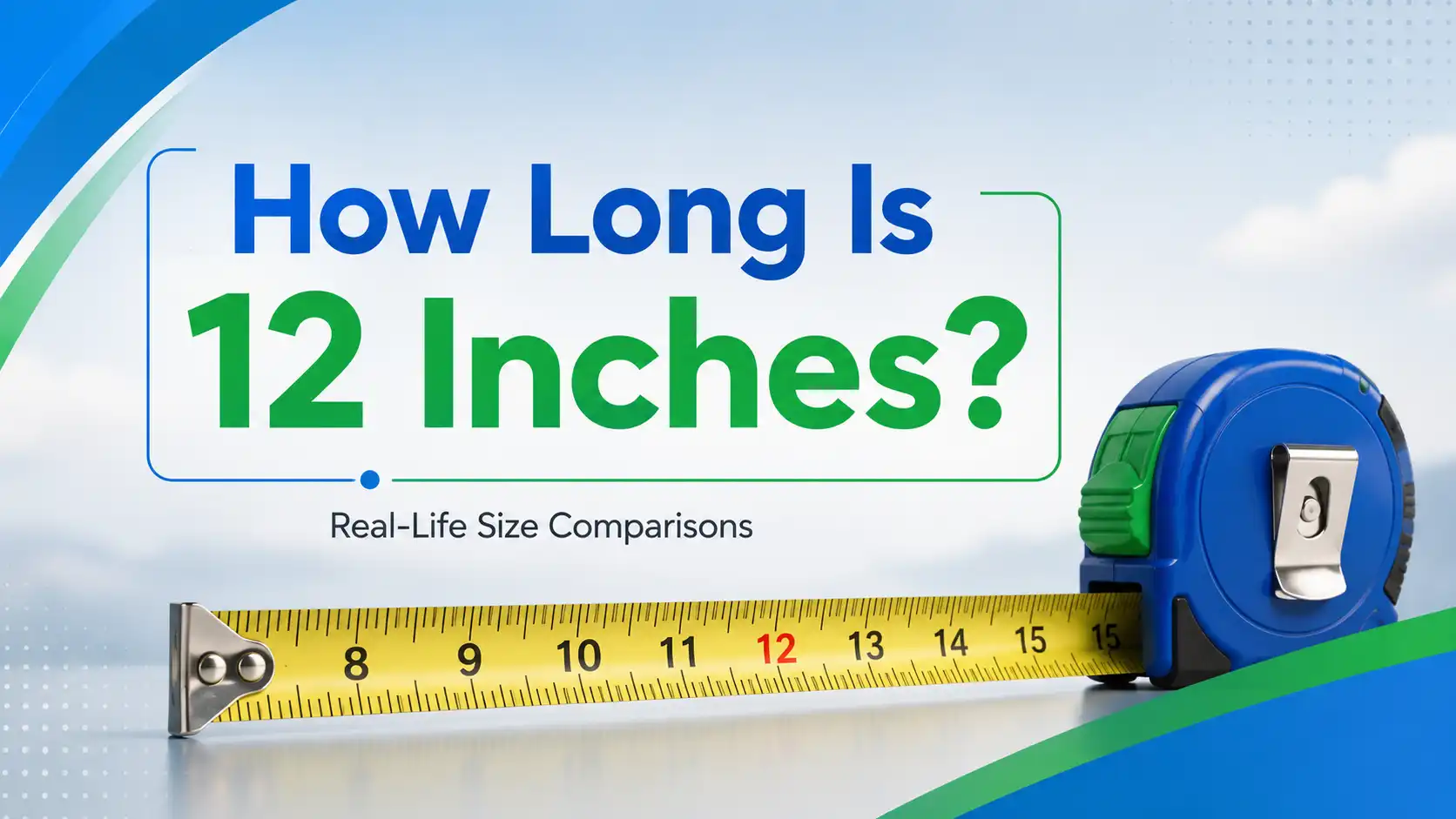
How Long Is 12 Inches? 12 Everyday Size Comparisons
12 inches is exactly 1 foot, or 30.48 centimeters (304.8 millimeters). That makes it a useful real-world measurement you can picture with familiar objects. A 12-inch ruler and a standard 12-inch vinyl LP are exact references, while A4 paper and two U.S. dollar bills provide close everyday comparisons.
Introduction
If you are wondering how long is 12 inches, the simplest answer is one foot. In metric units, 12 inches equals 30.48 cm, or 304.8 mm.
Knowing the conversion is easy, but visualizing a foot can be harder when you do not have a ruler nearby. Everyday objects provide useful mental reference points, especially when shopping, working on a DIY project, measuring furniture, or helping a student understand length.
This guide explains exactly how long 12 inches is and compares it with familiar objects while clearly separating exact measurements from approximate ones.
Key Takeaways
- 12 inches = 1 foot exactly.
- 12 inches = 30.48 cm = 304.8 mm.
- A 12-inch ruler is a direct reference for one foot.
- A standard 12-inch vinyl LP is exactly 12 inches in diameter.
- The long side of A4 paper is about 11.69 inches, making it slightly shorter.
- Two U.S. dollar bills placed end to end measure about 12.28 inches.
- Body-based comparisons are useful only for rough estimates.
- Use a ruler or tape measure when precision matters.
12 Inches Conversion Table
The inch-to-centimeter relationship is exact: 1 inch = 2.54 cm. NIST lists 2.54 as the conversion factor from inches to centimeters.
| Unit | Equivalent |
|---|---|
| Inches | 12 in |
| Feet | 1 ft |
| Centimeters | 30.48 cm |
| Millimeters | 304.8 mm |
| Meters | 0.3048 m |
| Yards | 0.3333 yd |
So if a product description says it is 12 inches long, it is exactly one foot long.
How Long Is 12 Inches?
Twelve inches is a moderate everyday length. It is long enough to span a school ruler from end to end but short enough to fit comfortably across many desks, shelves, kitchen surfaces, and other household spaces.
The most important reference is simple:
12 inches = 1 foot.
In metric terms, that is 30.48 centimeters. If you imagine a straight line slightly longer than 30 centimeters, you are very close to picturing 12 inches.
The measurement is also easy to divide:
- 6 inches = half a foot
- 4 inches = one-third of a foot
- 3 inches = one-quarter of a foot
- 2 inches = one-sixth of a foot
This makes 12 inches especially practical for construction, crafts, furniture dimensions, classroom activities, and everyday estimates.
What Does 12 Inches Look Like?
The easiest way to visualize 12 inches is to picture a one-foot ruler lying flat on a table.
For a circular reference, a standard 12-inch LP record has a diameter of 12 inches. The Library of Congress describes 12-inch diameter as the identifying size for Columbia’s X-marked 12-inch records.
Another useful comparison is A4 paper. Its long side is about 11.69 inches, so it falls just 0.31 inch short of 12 inches. That difference is small enough to make A4 paper a useful visual reference, but it should not be described as exactly one foot.
Two U.S. dollar bills placed end to end are also close to the target. Each bill is approximately 6.14 inches long, so two together span about 12.28 inches. This makes them slightly longer than 12 inches.
The key is to remember that these objects do not all have the same accuracy. A ruler or standardized record gives a much stronger reference than a variable household item.
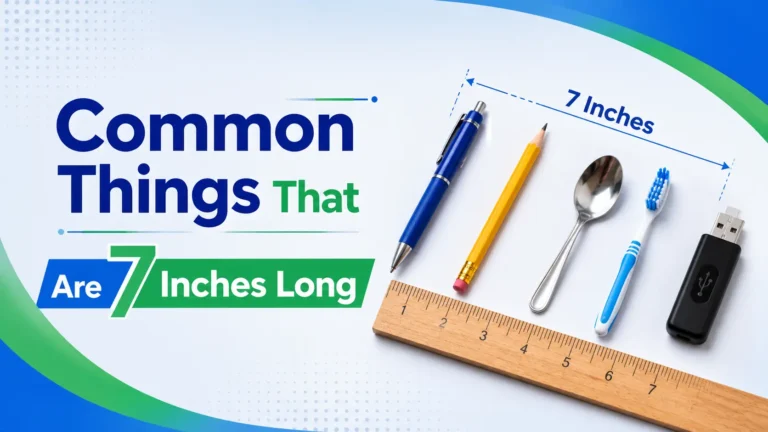
For another useful point of reference, you can compare 12 inches with How Long Is 7 Inches? The five-inch difference is large enough to notice visually, making these two measurements useful for understanding how inch measurements change in real-world objects.
Things That Are 12 Inches Long
Here are some useful real-world references for understanding a 12-inch length.
| # | Object | Relevant Measurement | Accuracy |
|---|---|---|---|
| 1 | 12-inch ruler | 12 inches long | Exact by intended scale |
| 2 | Vinyl LP record | 12-inch diameter | Standardized |
| 3 | Two U.S. dollar bills | 12.28 inches combined | Very close |
| 4 | A4 paper | 11.69 inches long | Very close |
| 5 | 12-inch pizza pan | 12-inch diameter | Product/model-specific |
| 6 | 12-inch wall clock | 12-inch diameter | Product-specific |
| 7 | 12-inch floor tile | 12-inch side | Product-specific |
| 8 | iPad Pro 12.9-inch, 2nd generation | 12-inch body height | Model-specific |
| 9 | Foot-long sandwich | About 12 inches | Product/serving-dependent |
| 10 | Compact rolling pin | Around 12 inches | Approximate |
| 11 | Shoe box | Often near 12 inches | Approximate |
| 12 | Adult forearm | Often near one foot | Approximate |
A 12-Inch Ruler
A 12-inch ruler is the most straightforward physical reference because its measurement scale is specifically designed around inches.
A standard ruler marked to 12 inches gives you a direct visual representation of one foot. It is particularly useful for students, crafts, woodworking, school projects, and small DIY jobs.
When using a ruler as a reference, focus on the 12-inch marking, rather than assuming the entire physical body of every ruler must measure exactly 12 inches from its outer edges.
Accuracy: Intended measurement reference.
A Vinyl LP Record
A standard LP record is one of the clearest circular examples of 12 inches. Its diameter is 12 inches.
This is different from saying that the record is 12 inches long because it is circular. The correct comparison is its diameter from one edge straight across to the opposite edge.
The Library of Congress identifies 12-inch diameter as the X size used for Columbia’s 12-inch records.
Accuracy: Standardized diameter.
Two U.S. Dollar Bills End to End
A U.S. banknote measures about 6.14 inches in length. Two bills lined up end to end therefore span about 12.28 inches.
That is only 0.28 inch longer than 12 inches, so two bills make a convenient wallet-based estimate.
The important detail is that this is a close comparison, not an exact 12-inch measurement.
Accuracy: Very close approximation.
A4 Sheet of Paper
A4 paper measures approximately 8.27 × 11.69 inches.
Its long edge is therefore just 0.31 inch shorter than 12 inches. If you have A4 paper nearby, placing its long edge next to a 12-inch ruler gives you a useful visual sense of the difference.
Because A4 is standardized, the comparison is more reliable than using an unspecified notebook or sheet of paper.
Accuracy: Standardized, but slightly shorter than 12 inches.
A 12-Inch Pizza Pan
A pizza pan sold as a 12-inch pan provides a useful circular comparison. The stated measurement normally refers to the pan’s diameter.
A 12-inch pan therefore gives you a one-foot span from one side to the other across its circular diameter.
Be careful with pizza-related comparisons, though. A pizza itself may have manufacturing and serving-size variation, so a specific 12-inch pan is a better measurement reference than simply saying “a medium pizza.”
Accuracy: Product-specific.
A 12-Inch Wall Clock
Some wall clocks are designed with a 12-inch overall diameter.
If you have a clock labeled or specified as 12 inches, its outside diameter gives you another circular one-foot reference.
This is particularly useful for homeowners because you can visualize the measurement on a wall instead of only imagining a ruler.
Accuracy: Product-specific.
A 12-Inch Floor Tile
Square tiles are commonly sold in specific nominal sizes, including 12 × 12 inches.
A tile with a verified 12-inch side gives you a useful flat-surface comparison. The key is to check the actual product specifications because nominal tile sizes can differ slightly depending on the product.
For DIY work, never assume every tile described casually as “12-inch” will have identical finished dimensions.
Accuracy: Product-specific.
iPad Pro 12.9-inch, 2nd Generation
The 12.9-inch iPad Pro 2nd generation is an interesting example because its physical height is actually 12 inches.
Apple’s specifications list the device at 12 inches high, 8.68 inches wide, and 0.27 inch deep.
This makes the model a genuine 12-inch physical-length reference.
It is important not to confuse this with the device’s 12.9-inch display, which refers to the screen’s diagonal measurement rather than the tablet’s height.
Accuracy: Model-specific manufacturer specification.
A Foot-Long Sandwich
A sandwich sold as a “footlong” is intended to represent approximately one foot of length.
That makes it a memorable everyday comparison, especially because the name itself is based on the one-foot measurement.
However, a prepared food item can vary because of bread shape, cutting, handling, and serving practices. For that reason, it is better treated as a practical visual reference than as a precision measuring instrument.
Accuracy: Approximate/product-dependent.
A Compact Rolling Pin
Some compact rolling pins are manufactured at lengths close to 12 inches.
This can make one a useful kitchen-based reference if the specific rolling pin’s dimensions are known.
Because rolling pins come in many sizes, however, you should not assume that every rolling pin is one foot long.
Accuracy: Approximate unless the model specification confirms 12 inches.
A Shoe Box
Some shoe boxes have a length close to 12 inches, particularly boxes designed around certain footwear sizes.
But shoe-box dimensions vary by shoe size, brand, construction, and packaging design.
That makes a shoe box a recognizable visual comparison, but not a dependable measurement standard.
Accuracy: Approximate.
An Adult Forearm
The distance from the wrist to the elbow can sometimes come close to 12 inches, making it a convenient body-based estimate.
However, this measurement varies substantially from person to person. It should never be treated as an exact one-foot reference.
If you use your forearm to estimate 12 inches, remember that you are making a rough visual approximation.
Accuracy: Approximate and person-dependent.
How to Estimate 12 Inches Without a Ruler
You can estimate one foot using familiar objects, but the accuracy depends on the reference.
Method 1: Use a 12-Inch Reference
If you have access to a 12-inch ruler, measure the target once and remember what one foot looks like.
This is the best way to create a reliable mental reference.
Method 2: Use Two Dollar Bills
Place two U.S. dollar bills end to end.
At approximately 6.14 inches each, they span about 12.28 inches. That puts the combined length only 0.28 inch beyond the target.
It is useful for quick estimates, but it is not an exact 12-inch measurement.
Method 3: Compare With A4 Paper
Place the long side of an A4 sheet against the distance you want to estimate.
At approximately 11.69 inches, A4 is just 0.31 inch shorter than one foot.
This is especially useful for students or office workers who regularly have paper nearby.
Method 4: Use a Known 12-Inch Product
A verified 12-inch tile, ruler, pizza pan, or other manufactured item can provide a physical reference.
Check the manufacturer’s listed dimensions first when accuracy matters.
Method 5: Use Your Forearm
Measure from your wrist crease toward your elbow as a rough reference.
Hand and arm dimensions vary, so this method is useful only when you need an approximate size.
Important: Body-based measurements are not standardized. Always use a ruler or tape measure for precise work.
Common Uses of 12 Inches
A one-foot measurement appears in many everyday situations.
Home Improvement
Twelve inches is frequently encountered when planning shelves, tiles, storage areas, trim, and other household dimensions.
DIY and Woodworking
A 12-inch length is convenient for small cuts, templates, craft projects, and layout work.
Furniture
Furniture dimensions are often described in inches, so understanding one foot makes it easier to visualize shelf depth, drawer dimensions, and available space.
School and Crafts
Students regularly encounter 12-inch rulers when learning fractions, geometry, measurement, and practical math.
Shopping
Online product listings may provide dimensions in inches. Knowing what 12 inches looks like can help you judge whether an item will fit on a shelf, desk, countertop, or inside a storage space.
11 vs. 12 vs. 13 Inches
Small differences become easier to understand when you compare nearby measurements.
| Measurement | Centimeters | Visual Difference |
|---|---|---|
| 11 inches | 27.94 cm | 1 inch shorter |
| 12 inches | 30.48 cm | Target measurement |
| 13 inches | 33.02 cm | 1 inch longer |
The difference between each neighboring measurement is exactly 1 inch, or 2.54 cm.
That may not sound large, but a one-inch difference can matter when measuring furniture, cutting material, choosing storage space, or checking whether an item will fit.
Measurement Tips
For an accurate 12-inch measurement:
- Start at the ruler’s zero mark.
- Keep the ruler straight along the measurement line.
- Check whether you are measuring length, width, height, or diameter.
- Do not use a screen’s diagonal measurement as its physical height or width.
- Check manufacturer specifications for products.
- Measure twice before cutting materials.
- Use a tape measure when the object is longer than a standard ruler.
- Treat body-based estimates as approximate only.
Conclusion
Twelve inches is exactly one foot, equal to 30.48 centimeters or 304.8 millimeters. The easiest way to visualize it is with a 12-inch ruler, while a 12-inch LP record provides a useful circular reference.
A4 paper is slightly shorter, and two U.S. dollar bills are slightly longer, making both helpful approximate comparisons. For shopping, DIY work, or furniture planning, these references can help you picture one foot quickly. When precision matters, always confirm the measurement with a ruler or tape measure.
FAQs
How many centimeters is 12 inches?
12 inches equals exactly 30.48 centimeters. The conversion is based on the exact relationship of 1 inch = 2.54 centimeters. In millimeters, 12 inches equals 304.8 mm.
Is a 12.9-inch tablet 12 inches long?
Not necessarily. A 12.9-inch tablet usually refers to the diagonal screen measurement, not the device’s physical length. For example, Apple’s 12.9-inch iPad Pro 2nd generation has a physical height of 12 inches, but its screen diagonal is 12.9 inches.
What everyday object is exactly 12 inches long?
A 12-inch ruler is the most direct reference. A standard 12-inch LP record also has a 12-inch diameter. Other objects can be manufactured at 12 inches, but their dimensions should be checked because products such as pizza pans, clocks, tiles, and shelves can vary.
How many millimeters is 12 inches?
12 inches equals 304.8 millimeters. Since 1 inch equals 25.4 millimeters, multiplying 25.4 by 12 gives 304.8 mm.
Is 12 inches exactly one foot?
Yes. 12 inches is exactly 1 foot. This is not an approximation. The foot is defined as 12 inches in the U.S. customary system.
What does 12 inches look like?
A 12-inch ruler is the simplest visual reference because it directly represents one foot. A standard 12-inch LP record also provides an exact circular reference by diameter. A4 paper is slightly shorter at about 11.69 inches along its long edge.
How can I estimate 12 inches without a ruler?
Two U.S. dollar bills placed end to end measure about 12.28 inches, making them a useful close estimate. The long edge of A4 paper is another reference at about 11.69 inches. Body measurements such as forearm length can also help, but they vary from person to person.
Is 12 inches longer than a dollar bill?
Yes. A U.S. dollar bill is about 6.14 inches long, so a single bill is roughly half of 12 inches. Two bills placed end to end measure about 12.28 inches, which is slightly longer than one foot.